Kitchen vs. Bathroom: The Ultimate Guide to Remodeling ROI for Dallas Homeowners
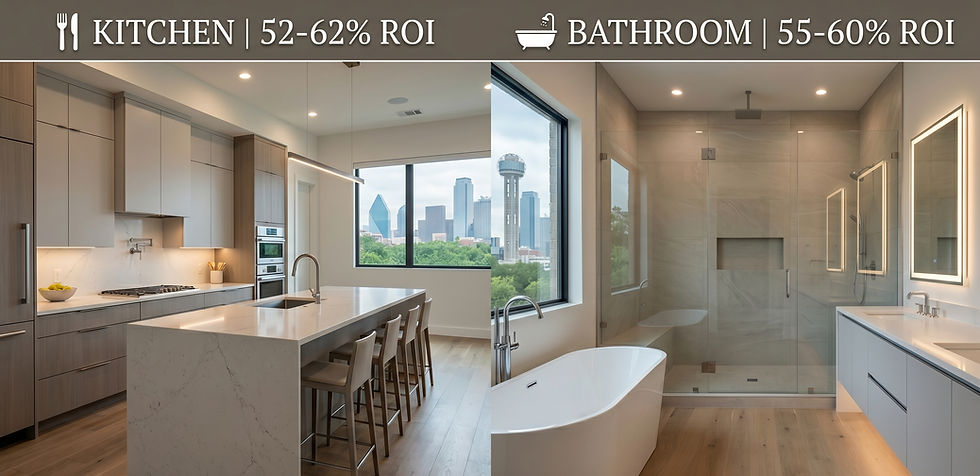
As the Dallas-Fort Worth metroplex continues its trajectory as one of the most robust real estate markets in the United States, homeowners are increasingly looking at their primary residences through the lens of an investment portfolio. In 2026, the local market has matured; buyers are no longer satisfied with "surface-level" flips. They are looking for structural integrity, modern efficiency, and high-functioning design.
When considering a renovation, the most common dilemma is where to allocate the capital: the kitchen or the bathroom? This guide provides an objective, data-driven analysis of how these two rooms impact property value, the mathematical reality of recouped costs, and the specific trends currently influencing Dallas appraisals.
1. Defining the Remodeling ROI Formula
To make an informed decision, one must look past anecdotal evidence and focus on the math. ROI in remodeling is rarely about a 1:1 profit. Instead, it is a calculation of how much of the project’s cost is "recouped" in the final sale price of the home.
The industry-standard formula for calculating this value is as follows:
Recouped Value(%) = ((Estimated Increase in House Resale Value) / (Total Cost of the Remodel)) * 100
In the current Dallas climate, a well-executed remodel typically yields a recouped value between 52% and 62%. While some high-demand neighborhoods like Lakewood or Preston Hollow may see slightly higher returns due to low inventory, homeowners should generally expect that nearly half of the project's cost is an investment in their own quality of life rather than immediate cash equity.
2. The Kitchen: A Deep Dive into Marketability
The kitchen is frequently cited as the most important room in a residential property. From a psychological standpoint, it is the "command center" of the home. In 2026, the trend has moved away from purely aesthetic "show kitchens" toward high-utility spaces that accommodate multi-generational living and home-based professional lives.
Functional ROI vs. Aesthetic ROI
A kitchen remodel can be categorized into two types: minor and major.
Minor Kitchen Updates (Recouped Value: 60% – 72%): These involve replacing front-facing elements like cabinet doors, hardware, and appliances while keeping the existing footprint. Because the "bones" of the kitchen remain, the cost is lower, and the percentage of value recouped is historically higher.
Major Kitchen Overhauls (Recouped Value: 50% – 58%): This involves moving walls, plumbing, and electrical. While this adds the most significant "wow factor," the high cost of labor and structural engineering in 2026 often suppresses the percentage of ROI.
Regional Trends: What Dallas Buyers Want
In the Dallas market, "open-concept" is no longer a luxury—it is a baseline expectation. For townhouse owners in areas like The M-Streets, removing a partition wall to connect the kitchen to the living area is one of the most effective ways to increase a property’s "appraised flow."
3. The Bathroom: The Rise of the "Home Spa"
The bathroom has undergone a significant cultural shift. It is no longer viewed as a purely utilitarian space; it is now marketed as a wellness retreat. This shift is particularly visible in the Dallas apartment and condo markets, where space is limited, and the bathroom serves as the primary sanctuary from urban noise.
The Math of the Master Bath
Master Suite Renovation (Recouped Value: 55% – 60%): Converting a standard master bath into a "wet room"—where the shower and a freestanding tub share a single glass-enclosed area—is the leading trend for 2026.
Secondary Bath Updates (Recouped Value: 45% – 55%): While less glamorous, a clean, modern guest bath ensures that the property doesn't have "dead zones" that turn off potential buyers.
The "Maintenance" Factor
Bathrooms are prone to moisture issues. In an appraisal, a bathroom with any sign of dated plumbing or water damage is a massive liability. Therefore, a remodel that updates pipes and installs modern waterproofing adds "invisible value" that prevents price haggling during the inspection phase.
4. The Apartment and Townhouse Perspective
Dallas's skyline is more residential than ever. For those living in Uptown high-rises or North Dallas townhomes, remodeling ROI is influenced by different variables than suburban detached homes.
The Vertical Challenge
In an apartment complex, you cannot expand your footprint. Therefore, ROI is found in quality and cleverness.
Custom Cabinetry: Utilizing vertical space in a Dallas apartment kitchen can make a 600-square-foot unit feel significantly larger.
Soundproofing: Upgrading flooring with high-rated acoustic under layments is a "hidden" improvement that adds immense value to buyers who prioritize privacy in dense buildings.
Townhouse Layouts
Townhouses often suffer from narrow layouts and limited natural light. Replacing dark, heavy finishes with light-reflective materials (such as pale wood floors and polished quartz) is a cost-effective way to improve the "perceived volume" of the home, which directly correlates to a higher asking price.
5. Beyond the Room: The "Flooring and Flow" Secret
Data from 2025 and early 2026 suggests that the most successful remodels are those that create a cohesive narrative throughout the home.
Cohesive Flooring ROI
One of the highest-impact improvements a homeowner can make is the installation of unified flooring across the main level. Mismatched flooring (carpet in the living room, tile in the kitchen) creates "visual friction" that makes a space feel smaller.
The 2026 Choice: Wide-plank engineered hardwood or high-durability luxury vinyl tile (LVT) that mimics natural stone.
Impact: This can increase the speed of a sale by up to 30%, even if it doesn't drastically change the "appraised" price.
6. The "Joy Score": A Non-Financial Metric
While this guide focuses on ROI, it is important to mention the "Joy Score"—a metric developed by real estate associations to measure homeowner satisfaction after a project.
Kitchens typically score a 9.6/10.
Bathrooms typically score a 9.3/10.
For homeowners planning to stay in their Dallas residence for 3–5 years or more, the "Joy Score" is often more valuable than the Recouped Value. A home that functions perfectly for your lifestyle is a success regardless of the resale math.
7. Avoiding the "Sunk Cost" Trap in Dallas
"Over-improving" is the primary reason homeowners lose money on renovations. In Dallas, every neighborhood has a "value ceiling."
How to Calculate Your Ceiling
Consult with a local real estate professional to find the average sale price of "recently renovated" homes in your specific ZIP code. If the average is $600,000 and your home is currently worth $550,000, your total renovation budget should ideally stay under $50,000 to maintain a healthy ROI. Spending $100,000 in this scenario would result in a "Sunk Cost" of $50,000 that the market will likely not pay back.
9. Conclusion: Finding the Right Balance
Ultimately, the choice between a kitchen and a bathroom remodel comes down to the current state of the property and the owner's long-term goals.
The Summary Checklist:
Prioritize the Kitchen if: The home has an "outdated" vibe from the moment you enter, or if the layout hinders daily family life.
Prioritize the Bathroom if: You are working with a smaller budget, living in an apartment, or if the master suite lacks the modern amenities expected in the current Dallas market.
Always Prioritize "On Time and On Budget": A renovation that drags on for months or spirals in cost will naturally diminish its own ROI through carrying costs and lost time.
In the competitive landscape of 2026, the most successful Dallas homeowners are those who approach remodeling with a clear head, a realistic budget, and a focus on quality over "flash." Whether it's a townhouse, an apartment, or a historic suburban home, the right improvement is the one that serves the owner today and the market tomorrow.


Comments